Background to Taxi Recapitalisation
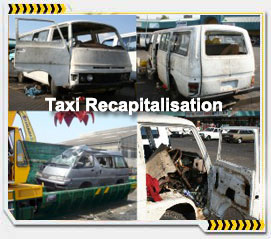 The taxi industry by far transports the biggest number of passengers on any given day, compared to both rail and bus. As part of Government’s intervention to improve the effectiveness of the industry since its de-regulation, The Taxi Recapitalisation Programme (TRP) is on course:
1. What is the Taxi Recapitalisastion Programme (TRP)?
The TRP is an intervention by Government to bring about safe, effective, reliable, affordable and accessible taxi operations by introducing New Taxi Vehicles (NTVs) designed to undertake public transport functions in the taxi industry.
2. What are the benefits of the TRP for the Taxi industry?
TRP is not only about scrapping old taxi vehicles but also about how best operators can be assisted to benefit constructively in the industry through empowerment.
TRP is about extending subsidized contract by exploring mechanisms on how the industry can benefit from the subsidy system.

3. FREQUENTLY ASKED QUESTIONS (FAQ)
3.1 Who qualifies to take part and benefit from the TRP?
All legal taxi operators in possession of Valid Operating Licenses linked to a legally registered taxi issued by an authorized Operating Licensing Board qualify to take part in the TRP
3.2 What are the basic requirements for participation in the TRP:
- Valid Operating License
- Vehicle legally registered as a Taxi
- Proof of ownership of the Taxi
- Valid South Africa identity document as issued by the Department of Home Affairs
- Proof of registration as a taxpayer with the South African Revenue Service
- Valid Certificate of Fitness for the taxi
3.3 What differentiates the NTVs from current taxis?
Through the introduction of the NTVs in the TRP, Government has for the first time prescribed “compulsory safety and other requirements” to protect passengers, operators, pedestrians, motorists and other road users. The compulsory requirements are also meant to ensure passenger comfort.
3.4 Through the TRP, Government has ensured the following:
- Introduction of safety requirements for passengers in the NTVs;
- Comfort for passengers by insisting on the size and number of seats in the NTV;
- Promotion of accessibility on the size and number of seats in the NTV;
- Branding and colour coding of taxi vehicles so that legal taxis could be identified and differentiated from illegal ones, and also that members of the public can easily identify a taxi vehicle.
 3.5 Renewal of the old taxi fleet
The NTVs will come in three categories, namely:
- M1 Minibus to carry: 9 - 16 people including the driver
- M2 Minibus to carry: 17 – 28 people including the driver
- M3 Minibus to carry: 29 – 35 people including the driver
3.6 What do the compulsory safety and other requirements entail?
The compulsory safety and other requirements for the taxis through the TRP are as follows:
- Type II A Brake system
- Rollover bars
- Seatbelts for all passengers in the taxi
- Maximum speed of 100km per hour
- Commercial 8 ply rated tyre of 14/185 or 14/195 for minibus taxis
- Reflective warning markings on the sides of the taxi
- Minimum seat size of 400mm
- No jockey or fold up seats
- One passenger on the front seat of the taxi (to make provision for electronic ticketing system)
- An interior notice indicating how many passengers should be carried by the taxi; and
- Dimensions for the provision of the wheelchair in the taxi, should the operator opt to purchase a taxi that is special –needs- people – accessible
3.7 Colour Coding for New Taxi Vehicles
Government has also published regulations on colour coding. All mini and midi buses operating in terms of an operating license shall be branded according:
- All mini- and midi-buses will be white in colour with the national flag on the sides; and
- Aluminium plate denoting the provincial coat of arms and route number ( as stated in the Government Gazette no. 29194 of 4 September 2006 – Regulation Gazette no. 8542)
3.8 Will the NTVs be affordable?
Government, SANTACO, Top Six, the National Taxi Alliance (NTA), banks and vehicle manufacturers will continue to interact so that they come up with affordable prices for the NTVs. There are many competing manufacturers and that will lead to the reduction of the NTV prices and also reduce the cost of capital. Government has further allocated an amount of R7.7 billion which will be used for the setting up of the Taxi Scrapping Administrator and for payment of the R50 000 scrapping allowance.
3.9 When will we see the new NTV’s?
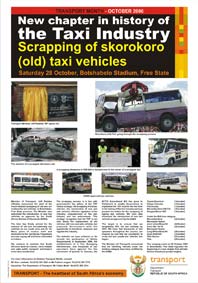
There are minibuses (18 – 35) taxi vehicles in the market that already meet some of the safety standards and other requirements. However some of these minibuses are still to meet and comply with outstanding safety requirements currently being concluded by the SABS. The current minibus sector is to a greater extent to meet and comply with a number of the safety and other requirements. New taxi vehicles to be launched on 28 October 2006 at Botshabelo Stadium, Free State Province.
3.10 What process must I follow to recapitalise my taxi?
a) How and where do I go to recapitalize my taxi?
The process of the current taxi is twofold
- The one process includes the Voluntary Exit from the Taxi Industry, and
- The Voluntary Exit process in only meant for operators who wish to exit the taxi industry once they receive their scrapping incentive of R50 000 per taxi vehicle after handing-in their old taxi vehicle plus the permit (even if not yet converted to an Operating Licenses) to pursue other interests.
Operators who wish to reduce their fleet by partly exiting and partly remaining also qualify to take part in this process. For example if an operator has five taxis and s/he wants to surrender only two taxi vehicles and their permits but remain in the industry to continue doing business with the other three legally operating taxis, such an operator would then qualify for immediate R100,000 for the two taxis to be surrendered and recapitialise the other three during the next phase of the roll out of the TRP.
At the next phase of the roll out the operator would still qualify to recapatilise the remaining three taxis by obtaining R50 000 per taxi to enable him/her to use the money as deposit for the three New Taxi Vehicles (NTVs).
The second process is the ultimate Recapitalisation of the taxis belonging to operators who wish to replace their taxis with NTVs and using the R50, 000 per legal taxi as deposits to purchase the NTV
The first process (voluntary exit) is to be preceded by the registration of “intention to exit”.
Applicants are NOT EXPECTED TO HAND IN THEIR TAXI VEHICLES AND PERMITS/OLSs YET, but are rather expected to go and register their intention to completely or partly exit. Applicants will then be called upon at a later stage to bring in their vehicles for actual scrapping once all the necessary supporting documents have been checked and verified. The taxi vehicles to be handed-in shall be checked and confirmed for authenticity.
Vehicles that are suspected of being stolen and or tampered with shall be handed over to the South African Police Services for investigation. During this period on processing of the application shall be undertaken until the SAPS conclude its investigation and duly communicate its findings to the Department of Transport.
Taxi vehicles to undergo any of the two phases and qualify for a scrapping incentive SHALL BE VEHICLES THAT CURRENTLY EXIST ON THE DATABASE OF THE DEPARTMENT OF TRANSPORT, registered and recognized as valid taxi vehicles. Taxi vehicles recently acquired for purposes of accessing the scrapping incentive SHAL NOT qualify.
b) Where do I go to register my voluntary exit?
Forms are available at the Offices of the local Provincial Operating Licensing Boards and can be submitted at no cost.
c) How will the scrapping incentive of R50, 000 be paid to me?
The scrapping incentive will be paid directly into the bank account of the successful applicant once the necessary processes have been completed.
d) The TSA will amongst other things undertake the following functions:
- Provide information on the TRP and how to go about applying for the scrapping incentive;
- Provide advice to the applicants;
- Verify all the documents supplied;
- Together with SAPS check, verify and authenticate all taxis handed in for scrapping;
- Store and safeguard the taxis before these undergo the actual physical scrapping;
- Undertake the physical scrapping of the taxis; and
- Affect the scrapping incentive to the successful applicants.
e) Will the scrapping facility be based in one province only?
No the handing-in of old taxi vehicles, application for the scrapping incentive, and application processing, will be done in all provinces and applicants do not have to travel from their respective provinces to a national office.
f) What will happen to operators who will totally ignore the TRP?
Operators who are currently operating unsafe vehicles will be given first preference to replace their old vehicles by first registering and subsequently replacing those vehicles. Other operators who are operating fairly new vehicles will be given a period of seven (7) years to replace their vehicles, failing which the will be subjected to law enforcement.
g) Who can be contacted for further information and or clarity on these matters?
Any Department of Transport (Provincial or National) can be contacted for further information.
Also view the following section:

For more information on Taxi Recap contact:
Mr. Maishe Bopape
Tel: (012) 309 3153
Or
Ms. Nomsa Mtshwene,
Tel: (012) 309 3125
On Transport Month contact:
Mr. Ntau Letebele,
Tel (012) 309 3845