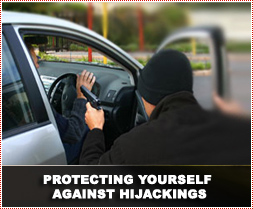
 Amidst the increase in hijackings in South Africa, it is very important to know some of the following aspects:
- How do the hijackers operate?
- When am I most at risk?
- How do I avoid being hijacked?
- What do I do when confronted?
How to Avoid a Hijack Situation
Sterling work has been done by specialists such as Richard and Melinda Rossouw of the National Hijack Prevention Academy [NHPA]. They have a vast experience in avoidance measures and also present driver training modules such as (a) Collision Avoidance/Skidpan and (b) Defensive Driving. They have made available to the public via the website www.hijack.co.za the following information on how to avoid a hijack situation. It is recommended to contact them via this website should you require further info on these and other courses.
Approaching and entering your driveway:
- 2km from your house strategy. Be extra alert. Switch off the car radio and concentrate on your surroundings. If you have noticed any vehicle behind you, use the techniques you have learned during the hijack prevention & survival course to determine whether you are being followed.
- Remember to stop your vehicle just on the inside of the gate and select reverse whilst waiting for the gate to close. This creates confusion and may buy you a few seconds for the gate to close completely behind you.
- Check your driveway and street before you leave or enter your premises.
- Make sure your driveway is well lit and clear from shrubbery where perpetrators can hide.
- Be aware of unknown pedestrians close to your residential address – do not turn into your driveway – pass and go back later.
- Liaise with your neighbours – know them.
- Be aware of vehicles parked close to your address with occupants inside. It might be perpetrators observing the area.
- Be alert if your animals do not greet you at the gate as usual. It might be that the perpetrators over-powered them.
- Phone your home and ask for someone to make sure your driveway is safe and to open and close the gate for you.
- When returning home after dark, ensure that an outside light is on, or have someone meet you at the gate. Check with your armed response company if they are rendering rendezvous services.
- If at any time you have to open the gate yourself, switch off the vehicle, leave the key in the ignition and close the door. Then open the gate.
- If you have small children in the vehicle, take the key with you (this is the only exception). You then need the key as a “negotiating tool”. The perpetrators want your vehicle and you want your children.
- If your children are older, it is advised that they exit the vehicle with you when opening the gate so that you are all separated from the vehicle should a hijack occur.
Parking your vehicle:
- Check rear-view mirror to ensure you are not being followed.
- When exiting your vehicle, be cautious and aware of surrounding obstructions and shrubbery that may be concealing a hijacker.
- Never sit in your parked vehicle without being conscious of your surroundings. Sleeping in a stationary vehicle is particularly dangerous.
- When approaching your driveway, be on the lookout for suspicious vehicles/persons. This is very important as the majority of hijackers approach their victims in home driveways.
Whilst entering your vehicle and while driving, the following should be considered:
- Have your key ready, but not visible.
- Inspect the outside and inside of the vehicle before unlocking. (Tyre, tyre, number plate, another side of the vehicle – as explained during the hijack prevention & survival course)
- Know your destination and directions to it, and be alert should you get lost.
- Always drive with your windows closed and doors locked.
- Make a mental note of any Police Stations in the vicinity.
- When stopping behind another vehicle, leave half a vehicle length in front of your vehicle to make an emergency escape if necessary.
- When dropping off a passenger, make sure they are safely in their own vehicle before departing.
- Avoid driving through high crime or unfamiliar areas.
- Avoid driving late at night / early hours of the morning when the roads are quiet.
- Drive in the centre lane away from pedestrians where possible.
- If possible, never drive alone.
- NEVER, EVER pick up hitchhikers or strangers. (VERY IMPORTANT)
- Never follow routine routes when driving; change on a regular basis.
Other situations:
- If approached by a stranger while in your vehicle, drive off if possible or use your hooter to attract attention.
- Lock your doors, close your windows and do not have bags or briefcases visible in the vehicle. Use the boot for this. Cell phone should also not be visible.
- There are times and days that these items are visible in the vehicle. Try and open the window they might “smash & grab” about 3 cm, so the window can absorb the sudden impact. If you’ve left your stopping distance you may be able to escape.
- Be constantly on the lookout for suspicious-looking characters or vehicles and do not hesitate to report them to the SAPS.
- Always be on the alert for potential danger, and be on the lookout for possible escape routes and safe refuge along the way.
- When approaching a red traffic light at night, slow down so that you only reach it when it turns green.
- Do not take anything from people standing at traffic lights or places where they gather (job seekers on gathering points). Perpetrators are usually standing among these people.
- Make sure you are not followed. If you suspect you are being followed, drive to the nearest Police Station or any busy public area.
- If any person or vehicle in a high-risk area arouses your suspicions, treat it as hostile and take appropriate action, e.g. when approaching a red traffic light, slow down, check for oncoming traffic and if clear, drive through the intersection. A fine will be preferable to an attack. Treat stop streets in the same way. Thereafter call for assistance if necessary. Always report these incidents to the SAPS. But remember, this is not an excuse to ignore the rules of the road. The onus will be on you to prove in a court of law that you had a justifiable reason to act the way you did and this is only in the case of a real, life-threatening emergency.
- Always have your identity document and driver’s license in your possession as well as a pen and notebook to take necessary notes.
- If possible, avoid driving in the dark. Hijackers may stage a minor accident, for e.g. If your vehicle is bumped from behind and you do not feel comfortable with the individual involved in the situation, indicate he/she must follow you and drive to the nearest Police Station or any busy public area for help.
- Never open your vehicle window or door for any stranger. If a suspicious person is near your unoccupied vehicle, do not approach the vehicle. Walk to the nearest public area and ask for assistance.
- If you encounter obstacles in the road, e.g. rocks, tyres, do not get out of your vehicle to remove them. Reverse and drive away in the opposite direction.
- Do not stop to eat or rest on deserted roads.
- Do not leave your vehicle unattended at a filling station.
- Cell phones should be carried on the body. Perpetrators will not allow you to remove your cell phone and valuables from the vehicle.
Information you should know:
If your vehicle is hijacked or stolen, promptly report it to the SAPS. Make sure you have the vehicle details: model, colour, vehicle identification and registration numbers available to assist with the recovery of the vehicle.
When forced to drive with a hijacker, be observant without making direct eye contact and try to memorise as many details as possible.
It is important to describe the hijacker as accurately as possible. When observing a hijacker, take note of his head and face – the shape of the eyes, mouth, nose and ears. Take note of possible irregularities. Look at the hair, skin colour, complexion and possible scars and tattoos. Observe the build, sex, body movement, clothing and any conversation that may take place.
- Remember the direction from which they came and fled, as well as the time and place the incident happened.
- Remember to make mental and physical notes immediately after the incident to ensure accurate and detailed information for the Police investigation.
Taken hostage - It can be helpful to have a survival plan in the back of your mind should such an incident occur. It is difficult not to become paranoid about being taken, hostage. However, it is just as easy to become complacent.
One very important fact to remember when being hijacked:
Should the conclusion of the drama be by way of armed intervention, and escape is not possible, immediately drop to the ground, remain still and obey the orders of the leader.
If confronted:
- Do not lose your temper, threaten or challenge the hijacker.
- DO EXACTLY AS TOLD BY THE HIJACKERS!
- Do not resist, especially if the hijacker has a weapon. Surrender your vehicle and move away. Try to put as much distance between yourself and the hijacker(s) as speedily as possible.
- Do not reach for your purse or valuables. Leave everything in the vehicle.
- Try to remain calm at all times and do not show signs of aggression.
- Be compliant to all demands set by the perpetrator.
- Do not make eye contact with the hijacker. He may perceive this behaviour as a threat and retaliate aggressively.
- Keep your hands still and visible to the hijacker, so as to give him assurance of your passive content.
- Do not speak too fast (if you are able to talk) and do not make sudden movements.
- Gather as much information as possible without posing a threat.
- How many people?
- How many firearms and description thereof?
- What were the perpetrators wearing (clothing)?
- To which direction did they drive off?
- Take note of the language they use (the accent).
- First phone the SA Police Service on 08600 10111. They will dispatch the medical services if needed. Other emergency numbers you could phone are 112 ANY Network (Vodacom+MTN+Cell C) or 147 Vodacom ONLY.
- Activate the vehicle tracking device if the vehicle is fitted with one.
Remember that your life is worth more than your vehicle!
For more information on the Hijack Prevention / Security Awareness Course, please contact:
Melinda Brussow
Cell: 073 161 2344
Tel: (012) 661-1388
Fax: 0866 317 527
Email: [email protected]
Website: www.hijack.co.za
Also View:
Hijack Prevention Guidelines
Truck Hijackings, Crime and Road Safety