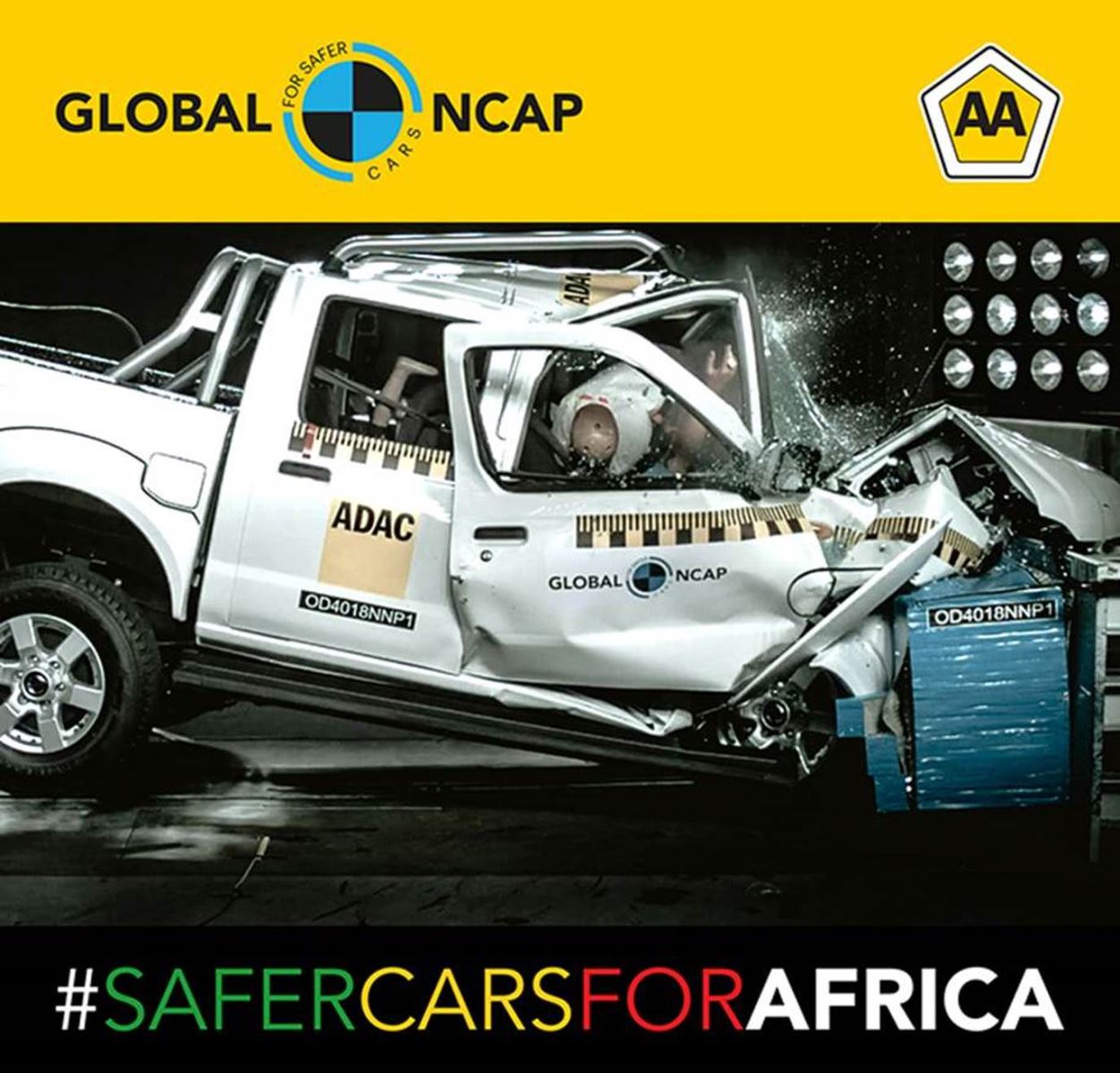
Global NCAP and the Automobile Association (AA) South Africa launch the second round of #SaferCarsForAfrica crash test results today with the welcome support of the FIA Foundation and Bloomberg Philanthropies. The four models tested show a wide range of safety performance, from zero to three stars for adult protection, with the Nissan NP300 ‘Hardbody’ scoring the lowest ratings which result in a high probability of life threatening injury in a crash.
The models tested are: Nissan NP300 Hardbody, Hyundai i20, Kia Picanto and Toyota Yaris. Global NCAP chose the entry-level version of each model and as a result all were fitted with at least one airbag as standard. The results highlight significant differences in the structural integrity of the vehicles tested.
Collins Khumalo, CEO of the AA of South Africa said,
“Of concern with these results is that the most expensive vehicle tested in this round – the Nissan NP300 Hardbody – produced the lowest score of all tests completed to date, achieving a 00.00 score and zero stars. There should be no zero rated vehicles on our roads.
“What these results show is that three vehicles priced lower than the Nissan produced three-star ratings for adult occupancy indicating that safety does not have to be tied to price. They also emphasize that cars may not be what they seem based purely on looks and descriptions, and that until many more vehicles are tested, this issue may be a much bigger problem throughout Africa than we originally believed.”
David Ward, Secretary General of Global NCAP said,
“A trio of three star results are acceptable but the zero star Nissan NP300 is shockingly bad. It is astonishing that a global company like Nissan can produce a car today as poorly engineered as this. The NP300 ‘Hardbody’ is ridiculously misnamed as its body shell has collapsed. Nissan also claim the car benefits from a so called ‘safety shield’ but this is grossly misleading. Our test shows that the occupant compartment completely fails to absorb the energy of the crash resulting in a high risk of fatality or serious injury. “
Saul Billingsley, Executive Director of the FIA Foundation said,
"The #SaferCarsForAfrica campaign introduces essential transparency to the South African car market, and these results show that consumers are still getting a raw deal. The ironically-named ‘Hardbody’ is the worst of the bunch, but all these car makers should be doing better, and offering the same high standard of safety in South Africa, and across the African continent, as they do in Europe and the US."
Kelly Larson, who directs the road safety program at Bloomberg Philanthropies, said:
"All car companies have the technology to make safe cars. The automobile industry must agree to meet the UN recommendations on vehicle safety standards across all market regions, including Africa, so all passengers can be protected in the event of a crash.”
Nissan NP300 ‘Hardbody’
The NP300 ‘Hardbody’ achieved an alarming zero star rating for its poor adult occupant protection mainly in the driver head and chest areas in the frontal crash test at 64km/h. The vehicle structure collapsed during the crash test and it was rated as unstable. The steering wheel column did not collapse penetrating the passengers’ compartment, creating an additional risk for the driver as it moved straight into the dummy chest. This performance showed a significant risk of injuries for the driver despite the car being equipped with double frontal airbags. The high probability of life threatening injuries to the driver’s head and chest resulted in the zero star adult occupant protection rating. Even with an airbag the driver’s head and chest showed high biomechanical readings. The NP300 ‘Hardbody’ achieved two stars for child occupant protection, the low result is mainly explained by the decision of the car manufacturer to install one of the Child seats without following Child seat manufacturer clear instructions.
Toyota Yaris
The Yaris achieved a three star rating for adult occupant protection in the frontal crash test at 64km/h. The vehicle structure was rated as unstable and offered marginal to good general adult occupant protection. The car provides seat belt reminders for both frontal positions. The car included seatbelts with pretensioners for both front passengers. Using the child seats recommended by Toyota, the Yaris achieved a three star rating for child occupant protection.
Hyundai i20
The i20 achieved a three star rating for adult occupant protection in the frontal crash test at 64km/h. The vehicle structure was rated as unstable as well as the footwell area. The protection levels ranged from marginal to good in adult occupant protection. The car offers seatbelt pretensioners for both front passengers and seatbelt reminder for the driver. Using the child seats recommended by Hyundai, the i20 achieved a two star rating for child occupant protection explained by the limited protection offered to the 3 year old dummy and lack of ISOFIX anchorages. The i20 structure is different to that of the European model. Safety equipment in South Africa does not offer Electronic Stability Control (ESC), side body airbags and side curtain airbags which are standard in Europe.
Kia Picanto
The Picanto achieved a three star rating for adult occupant protection in the frontal crash test at 64km/h. The vehicle structure was rated as stable while the footwell area was rated as unstable. The car offers seatbelt pretensioners for both front passengers and seat belt reminder for the driver only. Using the child seats recommended by Kia the Picanto achieved a two star rating for child protection. The detachment of the ISOFIX anchorages for the 3 years old CRS during the test explains the low score for child occupant protection. The manufacturer did not yet offer an explanation to this problem, but the child seat manufacturer which is also investigating, took immediate action and removed the Picanto from their recommended list of cars for this CRS model.
Global NCAP awards a separate child safety rating to each car in order to highlight the different levels of protection vehicles provide to passengers on the rear seats. Because the only safe way for young children to travel is properly restrained in a child seat, the assessment checks how compatible the car is with the child seats recommended by the manufacturer, as well as the protection provided in the crash test. Airbags are not a substitute for seatbelts, passengers must always wear seatbelts.
Only the Yaris and Picanto offered standard ISOFIX anchorages for child restraint systems (CRS). The NP300 Hardbody showed incompatibilities with the recommended CRS. Only the Yaris offered three-point seatbelt for all passengers facilitating the required conditions to safely install a child seat in all seating positions, while all the others offered a lap belt in the middle position which makes it impossible to properly install a CRS.