E-mobility is a global topic that is becoming increasingly important. Over 14 million e-vehicles were sold worldwide in 2023, 35 per cent more than in the previous year.
In South Africa, the Electric Vehicles White Paper ("White Paper") published in 2023 by the Department of Trade, Industry and Competition, represents a decisive step in the transformation of the South African automotive industry and lays the foundation for the development and implementation of the South African market for EV`s.
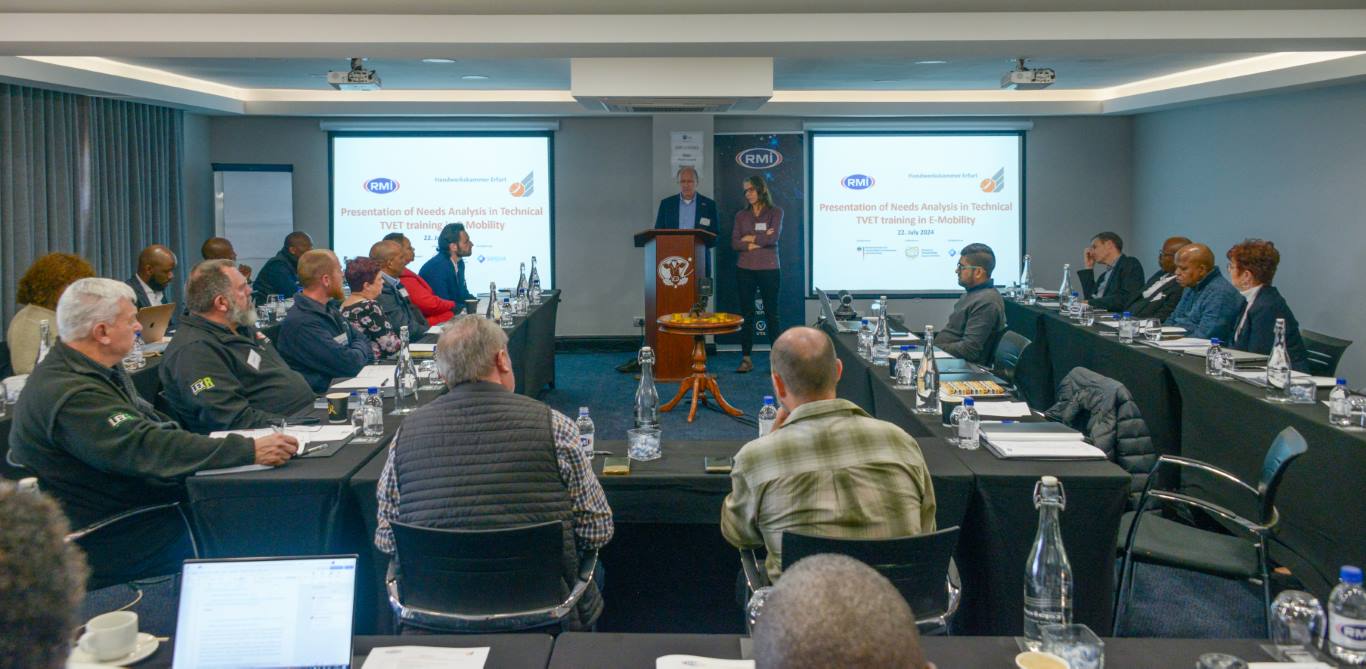
Major role players in the sector, including representatives from the Retail Motor Industry Organisation (RMI), German Embassy, Department of Higher Education and Training (DHET), Handwerkskammer Erfurt (HWK), Manufacturing, Engineering and Related Services Sector Education and Training Authority (merSETA), Technical Vocational Education and Training (TVET) colleges, the South African Public Colleges Organisation (SAPCO), the National Business Initiative (NBI) and the Electric Mission, gathered today (Monday 22 July) in Pretoria to reveal the results of a readiness study carried out by HWK and RMI at TVET colleges and companies in the automotive sector.
Frank Oelze , Head of Vocational Training Centre at HWK Erfurt noted that with the significant increase in demand for electric vehicles and the growing awareness of environmental issues, the country is faced with the challenge of training qualified specialists who can fulfil the new tasks. “Hybrid and electric vehicles not only place new demands on the industry, but also on service and workshop personnel. With practical technical qualifications and customer-oriented service structures, consumer-oriented services for vehicle maintenance and charging facilities can, and must be created and further developed, and the many opportunities for integrating new decentralised sources of renewable energy must be exploited,” he says.
Ipeleng Mabusela, RMI CEO Strategy and Corporate Support, concurs saying the shift towards EVs transcends environmental benefits. It presents a powerful opportunity to empower all South Africans including women, youth and young black South Africans who can lead the charge in this technological revolution. “The timing is particularly key. We have a new government of national unity and collaborative partnerships are going to be key. EVs are on the rise in SA but not without challenges such as affordability with high interest rates and range anxiety. The potential to grow our sector, which already contributes 5% towards GDP - with the aftermarket specifically contributing 2% and providing 300 000 jobs – is exciting. We have the potential to attract rising talent and a more diversified workforce but we will require more from a legislative perspective to drive consumer demand and a firm focus on training and skills development to formalise ongoing training efforts and ensure industry-wide recognition for qualified professionals,” he says.
Mabusela says from a progress perspective the RMI is fortunate to have had a long-standing collaboration with HWK through a ground-breaking initiative launched in 2023 to equip TVET lecturers with the knowledge and skills needed to prepare students for the future of automotive technology. “Recognising the vital role TVET lecturers play in shaping the next generation, we've also extended our commitment through collaboration with Porsche AG's Porsche Aftersales Vocational Education (PAVE) team. Their invaluable contribution of a VW e-Up! has made practical training modules a reality, ensuring lecturers are equipped with cutting-edge knowledge and practical experience to effectively train future generations of technicians for the electric vehicle revolution.”
The results presented at the presentation today represent an in-depth needs analysis undertaken by HWK and the RMI at selected TVET Colleges between July 2023 and July 2024. They serve as a basis for assessing the needs and scope of a possible follow-up project to establish sustainable training structures for vocational school lecturers in the field of e-mobility nationwide.
Over 500 South African companies working in the automotive sector were included and quality feedback was received from 58 organisation and 35 TVET colleges.
High level results from the Colleges which have a significant influence on the quality of vocational education and training revealed:
• 84% of TVET Colleges were not fully aware of the technical skills and knowledge required by technical specialists in electric and hybrid vehicle technology and almost 90% of lecturers at TVET colleges have not yet received any specific training in the field of electric and hybrid vehicle technology.
• Almost 90% agreed there is a shortage of qualified TVET lecturers with expertise in the field of e-mobility in South Africa
• Almost 100% agreed the following 5 areas required training: Battery technology and maintenance; Electric drive systems and components for the drivetrain; High-voltage safety and protocols; Diagnosis and repair techniques for electric vehicles and Integration and maintenance of hybrid systems
• They unanimously agreed to better align their programmes with the skills needed they would require funding and financial support; access to suitable equipment and facilities; opportunities for collaboration with industry partners; development and updating of curricula and training and development of lecturers.
Oelze said in general most respondents said they would welcome any government or industry interventions to support the topic of e-mobility as well as efforts to increase the number of female lecturers.
High level insights from the 58 companies who participated revealed that most of the conceptual skills required by potential young professionals relate to the areas of diagnostics and electrics/electronics. “The need for mechanical and electronic knowledge as well as solid specialist knowledge was also repeatedly emphasised.”
The relatively frequent mention of IT and computer skills suggests that companies see a need here that is not adequately covered during basic school training. The topic of soft skills also plays an increasing role. “It was noticeable that health and safety at work only came last in the skills requirements mentioned,” notes Oelze.
When looking for skilled workers, almost 2/3 of companies complained about the lack of competent specialists and qualification deficits among their staff - at least in the area of modern vehicle technologies / hybrid and e-mobility and especially in electronic knowledge. The lack of computer skills was also criticised among existing staff and/or applicants. “Some companies are faced with the problem of not knowing about appropriate training opportunities or industry-specific standards or certifications for their employees. Others see a risk of a brain drain. However, around 1/3 of South African companies in the automotive sector do not yet see a need for qualified specialists in this area,” he said.
When it comes to school-based vocational training at TVET colleges, a clear majority (over 80%) of companies believe that the topic of hybrid and e-mobility is not adequately covered and also point to the lack of appropriately qualified lecturers. Over 1/3 of those surveyed see potential for improvement in practical teaching. They recommend practice-oriented training from the various manufacturers and access to relevant manuals to qualify TVET lecturers. In the following places, the company representatives would like to see greater integration of modern technology, such as hybrid or e-mobility content, as well as generally better basic teaching of electronic knowledge. To develop practice-oriented curricula, almost 2/3 of companies are calling for greater cooperation between industry, educational institutions and political decision-makers. Many companies also recommend more internship opportunities for students before they go to work in companies after completing their school-based vocational training.
Overall, the study shows a clear need for qualified specialists and therefore also for the introduction or adaptation of vocational training programmes in this area.
“Companies and vocational training institutions are aware that in the future, but also currently, a higher level of qualification of specialists for the development, design, manufacture and customer service of electric vehicles and the associated components is necessary. The necessary equipment at the vocational training institutions must be supported (financially) by politicians and by industry,” he says.
Mabusela concluded by thanking all parties for the excellent work and commitment to the project. “We acknowledge the challenges with our TVET colleges, underutilised equipment and outdated learning materials, but we are optimistic about our partnerships and particularly about the establishment of an electromobility qualification on the South African National Qualifications Framework this year. Such a qualification will formalise ongoing training efforts and ensure industry-wide recognition for qualified professionals. We warmly embrace our partnership with HWK, merSETA and QCTO in establishing an Advanced Competency Development Centre for New Energy Vehicles. This initiative, supported by PAVE and SAPCO, has the potential to redefine career pathways in the repair and maintenance of new energy vehicles. Education is definitely the start to solve our societal challenges and support our current and future auto sector workers.”