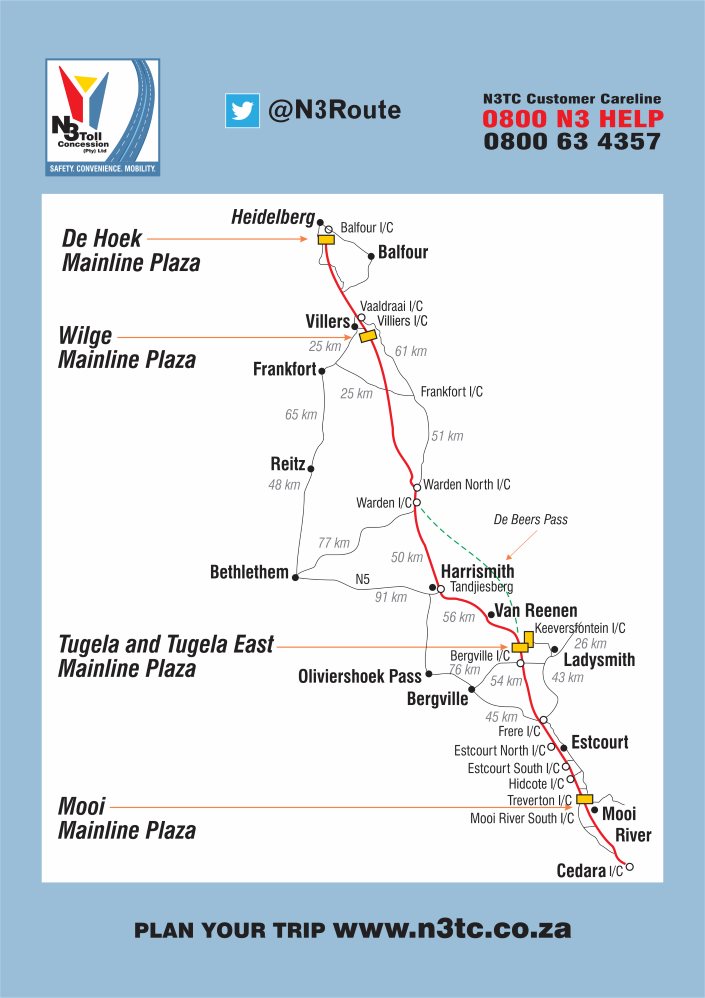
N3 Toll Concession (N3TC), the company managing the N3 Toll Route between the Cedara interchange in KwaZulu-Natal and the Heidelberg interchange in Gauteng, reviews traffic patterns and crash data on a continuous basis in a bid to improve road safety and road users’ travel experience.
Data for the first quarter of 2018 indicates an overall traffic growth of 4,4% compared to the same period in 2017. Traffic over the Easter long weekend (the busiest period on the N3 Toll Route) also increased by 4,3% versus 2017.
However, due to the protest action and temporary road closure in the Mooi River area experienced on Easter Monday, approximately 17000 vehicles had to be diverted from the Mooi Toll Plaza. The majority of these were light motor vehicles as heavy vehicles were stacked on the N3 Toll Route until passage was safe again.
Despite the increase in traffic, only one fatality was reported during the Easter weekend along the entire Route. This was a pedestrian fatality near Warden in the Free State.
Furthermore, a 40,63% reduction in fatalities has been recorded from January to March 2018, with pedestrian fatalities decreasing by 50% (from 14 in 2017 to 7 in 2018). “Although the number of vehicle crashes increased by 13.5% during the first quarter of 2018 (274 in 2017 to 311 in 2018), N3TC is heartened by the marked decrease in the severity of crashes,” says Miles le Roux, traffic engineer of N3 Toll Concession.
Wet weather was a contributory factor in 23.2% of the slight-injury crashes that were recorded along the N3 Toll Route. The majority of crashes (164) occurred at night as opposed to 147 daytime crashes.
Human error was the main cause in both heavy vehicle and light vehicle crashes followed by vehicle failures (including tyre blow outs and brake failure).
The top three types of crashes were listed as: vehicle left road (32,2%); vehicle rolled (16,1%); head-tail/moving vehicle (13,2%).
Together with its partners in road safety, N3TC Road Incident Management Systems (RIMS) has instituted various safety interventions as part of a comprehensive plan to effectively address road safety issues along the Route. These include joint initiatives to:
• build road safety management capacity
• improve the safety of road infrastructure and transport networks
• enhance the behaviour of road users, and to
• improve post-crash care
“Over the last three years, a vast improvement in visible policing and active law enforcement along the entire Route was noted, especially during peak traffic periods. I have no doubt that the pro-active partnerships with law enforcement agencies and emergency services are bearing fruit. In the past month, regular traffic check point exercises by all the Roads Traffic Inspectorate (RTI) officers and the SA Police Service in the four provinces (Gauteng, Mpumalanga, Free State and KwaZulu-Natal) through which the N3 Toll Route passes, managed to control the alarming increase in serious crashes,” says le Roux.
As an example, the following efforts during the Easter long weekend had a marked impact on the overall safety of road users along the N3 Toll Route.
• integrated road blocks along the Route focused on checking for roadworthiness of vehicles, public transport compliance, drivers under the influence of alcohol and/or other substances, and looking out for wanted criminals;
• over a 12-day period (from 29 March to 09 April) thousands of vehicles were checked and searched at a 24-hour joint RTI and SAPS operational traffic checkpoint at Dasville in Mpumalanga;
• a further six temporary satellite stations were manned by RTI, SAPS, Emergency Medical and Fire Services, and the N3TC Route Patrol Service along the Route. They provided pro-active road safety interventions throughout the Easter peak period;
• specialist medical rescue services and roadside assistance were supplied by Community Medical Services (CMS), Volunteer Rescue Team (VRT) and BMW SA to bolster road users’ safety along the Route;
• heightened speed enforcement along all sections of the N3 Toll Route improved general driver compliance.
“Apart from our partnerships with various emergency and law enforcement agencies, N3TC provides a daily 24-hour Route Patrol Service as part of our Road Incident Management System (RIMS) to assist with clearing major incidents along the Route, providing crash scene safety, help stranded road users and to provide roadside assistance, route maintenance and general road safety services.
In their endeavour to help make the N3 Toll Route safer for all our road users, the Route Service Patrol teams travel more than 135 000 kilometres along the N3 during a single month.
In March 2018 alone, the patrollers attended to 118 crashes, assisted 132 road users, made 228 courtesy stops, changed 448 tyres, removed 324 objects along the road and attended to 15 vehicle fires,” says le Roux.
“Apart from the human trauma suffered as a result of motor vehicle crashes, the associated cost in terms of providing emergency support, damage to infrastructure, logistical setbacks and time delays remain of critical concern. Reviewing our crash reports, the number of vehicles damaged in crashes and vehicle fires gives a further indication of the impact on our economy. As an example, in the first quarter 214 heavy vehicles, 204 light vehicles, 14 taxis and 6 buses were severely damaged in crashes and/or fires along the N3 Toll Route.”
“Although we are encouraged by the small gains we are making in enhancing road safety, none of us dare rest on our laurels. We need to continue strengthening our partnerships and efforts towards road safety; and these partnerships include vehicle drivers and owners also making road safety their first priority,” ends le Roux.