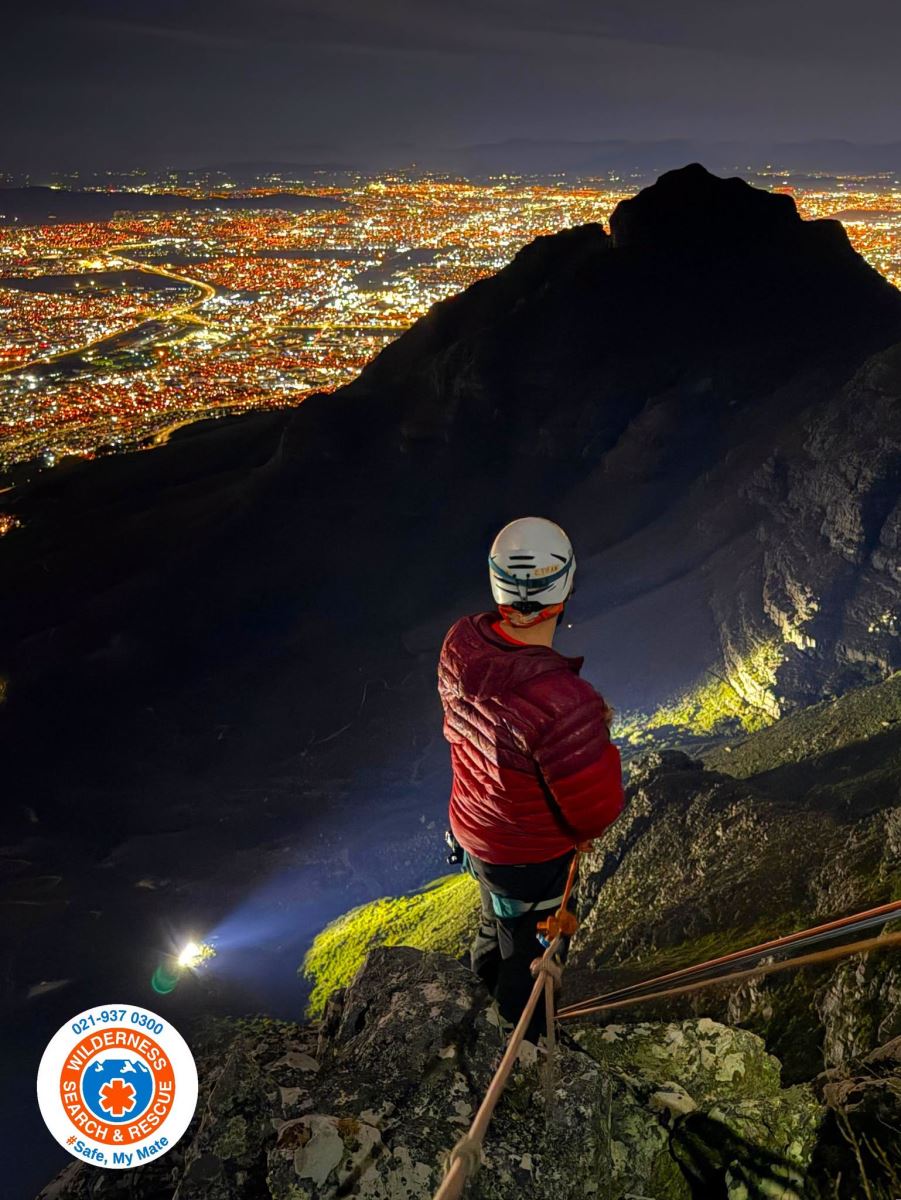
Seven incidents in one day. A new year-to-date record. And a growing call for all of us to look after the people who look after us.
Sunday, 25 October 2026
• Equalling WSAR's busiest day on record for only the third time in our history.
• Rescue incidents up over 500% – From 39 in 2000 to 235 in 2026, measured to 25 October.
• A new year-to-date record – Already 17.5% above the previous high recorded in 2024.
• 130-metre technical rescue – An injured hiker brought to safety after a night-long operation.
• 68 Days still to go – With the busy summer hiking season only beginning.
• A shared responsibility – Preparation, prevention and continued support for the people who come to our aid.
SEVEN RESCUES, ONE SATURDAY. BUT THERE'S A BIGGER STORY.
At 04h30 on Sunday morning, while most of Cape Town was still asleep, a group of exhausted mountain rescuers finally reached the upper cable station on Table Mountain.
They had spent much of the night working to bring an injured 24-year-old hiker to safety, raising him 130 metres up a cliff before carrying him to shelter from the elements.
Their work wasn't over. With strong winds making conditions difficult, they would have to wait several more hours before the cableway could bring them safely down the mountain.
For these volunteers, it had been a long night. For others, it had been an equally demanding Saturday.
Across Table Mountain, rescue teams had responded to seven separate emergencies. A helicopter had been deployed, injured hikers treated and evacuated, an EMS drone team included and stranded visitors helped to safety.
Meanwhile, other volunteers had spent their Saturday sharing safety advice and handing out water to hikers on Lion's Head, while specialist teams continued their technical rescue training near Kalk Bay.
For only the third time in our history, Wilderness Search And Rescue (WSAR) had responded to seven incidents in a single day, equalling our highest daily total.
But behind Saturday's remarkable efforts lies a much bigger story.
Every one of those seven incidents represents someone who needed help. And behind every response are people who put their own plans, families and responsibilities aside to provide it.
The number of people needing rescue is growing, and with it, the demands on the people who answer those calls.
With 235 incidents already recorded this year, and the busy summer hiking season still ahead, we believe it's time for a broader conversation about what these numbers mean, not just for our rescuers, but for all of us who enjoy the mountains.
THE NUMBERS TELL A STORY WE SHOULDN'T IGNORE
According to figures from the South African Mountain Accidents Database, 39 mountain rescue incidents had been recorded across our operational area by 25 October 2000.
At the same point in 2026, that number stands at 235.
That's an increase of more than 500% over the past 26 years.
Our previous highest figure for the same period was 200 incidents in 2024. We've already exceeded that by more than 17%, with 68 days still remaining in 2026.
And perhaps most concerning is that the traditionally busy summer hiking season is only just beginning.
We don't share these numbers to suggest that people are becoming more careless, or that anyone should think twice about asking for help.
There are many possible reasons why rescue numbers have increased, and the figures alone don't tell us what those reasons are.
But they do tell us something important.
More people are needing assistance, and we're asking more of the volunteers, specialist teams and partner agencies who respond.
Behind every one of those 235 incidents is someone who needed help. And behind every response are people who put their own plans aside to provide it.
Saturday was a powerful reminder of what that really means.
SEVEN INCIDENTS, SEVEN DIFFERENT STORIES
Our first call involved a young female hiker who tripped and fell, sustaining injuries. She was airlifted to a nearby landing zone before being transported to hospital.
Shortly afterwards, a 56-year-old American visitor collapsed while hiking Platteklip Gorge.
The Western Cape Government Health and Wellness EMS / Air Mercy Service (AMS) rescue helicopter was dispatched, and a rescuer was hoisted to the scene to assist the patient before he was airlifted to safety and transferred to a waiting ambulance
for further medical treatment.
Meanwhile, a couple attempting to descend the technical sections of India Venster called for assistance. While teams were responding, the hikers reported that they had managed to continue their descent slowly.
At the top of Platteklip Gorge, another male hiker was suffering from severe cramps and unable to continue. A responding Western Cape Government Health and Wellness EMS paramedic, together with SANParks - Table Mountain National Park
rangers provided treatment before assisting him to the upper cable station, where he was transported down the mountain.
Four very different situations, each requiring a response.
And as the afternoon progressed, the demands on our teams continued to grow.
A 130-METRE RESCUE AND A NIGHT ON THE MOUNTAIN
One of Saturday's most demanding operations involved a 24-year-old male hiker who had been attempting to scramble up a break in the cliffs above Union Ravine, away from the established trails.
He fell approximately four metres, sustaining injuries and becoming stranded on a small ledge.
Unable to continue, he called for help.
Our technical rescue teams were deployed to the scene, abseiling down the cliffs to reach him, assess his injuries and provide medical care.
What followed was a challenging rope rescue, with teams raising the injured hiker approximately 130 metres to the top of Table Mountain.
But reaching the top wasn't the end of the operation.
With the cableway no longer operating, rescuers carried the patient to the toilet facilities near the upper cable station, arriving at approximately 04h30 on Sunday morning.
There, they sheltered from the elements while waiting for an opportunity to evacuate.
Shortly after 08h00, the Table Mountain Aerial Cableway team, operating in exceptionally windy and challenging conditions, assisted in bringing the patient and rescuers safely down the mountain.
We owe the cableway team a special word of appreciation.
Their staff had remained on duty long after normal closing time on Saturday, helping transport rescuers and specialist equipment up and down the mountain. They returned to assist again on Sunday morning.
It's this kind of cooperation, often happening quietly behind the scenes, that makes difficult rescues possible.
MEANWHILE, THE CALLS KEPT COMING
Elsewhere, a 24-year-old female hiker twisted her ankle in Cecilia Forest. A responding paramedic assisted her safely back to the parking area, where she was collected by a friend.
Our seventh incident involved a 32-year-old Tunisian visitor who was hiking alone and following an unfamiliar route from the India Venster trail.
As darkness fell, he realised that he could no longer safely navigate the terrain and called for assistance.
This incident placed additional pressure on an already demanding evening, requiring valuable rescue resources to be diverted from the ongoing technical operation above Union Ravine.
To reach the stranded hiker as quickly as possible, rescue teams abseiled down from the cable car before hiking swiftly across the mountain to locate him along the Grotto Fountain Cairn Traverse.
This approach saved valuable time, allowing rescuers to reach him and assist him safely down the mountain.
And there's an important point worth making here.
Calling for help was the right decision.
We would much rather someone recognise that they're in difficulty and call early than continue into increasingly dangerous terrain.
But when several emergencies happen at the same time, every new call also means making decisions about where to deploy people and equipment, and how best to help everyone who needs assistance.
It's a side of mountain rescue that isn't always visible.
WHILE SOME TEAMS RESCUED, OTHERS WORKED TO PREVENT THE NEXT EMERGENCY
What makes Saturday particularly significant is that rescue operations were only part of what our teams were doing.
While some volunteers were responding to emergencies across Table Mountain, others were participating in a joint safety patrol on Lion's Head alongside our partner organisations.
They spent the day engaging with hikers, sharing safety advice and helping people who were struggling with the conditions.
More than 33 litres of water were handed out to hikers who had run out.
We can't know how many of those hikers might otherwise have needed assistance, but every person helped before a situation becomes an emergency is a potential rescue avoided.
At the same time, specialist technical rescue teams were conducting cave rescue training near Kalk Bay, maintaining and developing the skills needed to respond in some of the most challenging environments.
These activities don't always attract the attention of a helicopter rescue or a dramatic overnight operation.
But they're just as important.
Training prepares us for the next emergency. Prevention helps us reduce the chances of that emergency happening at all.
And both depend on people who continue to give their time, often without recognition.
THE PEOPLE BEHIND THE NUMBERS
There's something we hope everyone takes away from Saturday's events.
Our rescuers are ordinary people who make themselves available to help others.
They have families, careers, responsibilities and plans of their own.
Yet when someone needs assistance, they respond.
Sometimes that means leaving a family gathering. Sometimes it means spending the night on a mountain, caring for someone they've never met. And sometimes it means returning home exhausted, with little time to rest before the next working day
begins.
We are fortunate to have volunteers who continue to make these sacrifices, supported by professional emergency services and dedicated partner organisations.
But as the number of incidents increases, so too does the demand on their time, equipment and resources.
Our rescuers give their time freely, but every rescue comes at a cost.
There's the specialist equipment, training, transport and operational resources needed to respond. And there's also the personal contribution made by many volunteers, who fund much of their own equipment and expenses.
We are deeply grateful for the organisations, businesses and individuals who already support our teams.
As the demand for rescue services grows, that continued support becomes increasingly important.
Because sustaining mountain rescue isn't simply about having enough people willing to help. It's also about ensuring they have the training, equipment and resources to do so safely and effectively.
SAFE MY MATE – SOMETHING WE CAN ALL BE PART OF
We want people to enjoy our mountains.
They're an incredible part of where we live, and we want everyone, from experienced mountaineers to first-time visitors, to experience them safely.
But we also need to recognise that even familiar trails can be demanding, and that relatively small decisions can sometimes have serious consequences.
With a particularly hot summer forecast and the busiest hiking months still ahead, we're asking everyone to take a little extra care.
Our Safe My Mate message is about looking after ourselves and looking out for one another.
Perhaps it's checking that a friend has enough water before setting off.
Making sure someone knows where you're going and when to expect you home.
Taking a torch and warm clothing, even when the weather looks perfect.
Encouraging someone to turn around when conditions become difficult.
Or simply stopping to help a stranger who's struggling along the trail.
These might seem like small things, but they can make an enormous difference.
And if something does go wrong, please don't hesitate to call for help.
Calling early gives us more options, more time to respond and a better opportunity to bring everyone home safely.
Save the correct WSAR emergency number: 021 937 0300.
A HEARTFELT THANK YOU
We want to extend our sincere appreciation to every volunteer rescuer, paramedic, helicopter crew member, technical specialist, law enforcement officer, ranger and support team who contributed to Saturday's operations.
Special thanks go to our colleagues at the Western Cape Government Health and Wellness EMS, Air Mercy Service (AMS), SANParks - Table Mountain National Park, City of Cape Town Law Enforcement and the Table Mountain Aerial Cableway,
together with the many other individuals and organisations who continue to support our teams.
To those who spent their Saturday responding to emergencies, those who worked through the night, and those who continued with safety patrols and specialist training while others were rescuing, thank you.
Your commitment, compassion and willingness to help others are deeply appreciated.
We wish all the injured hikers and visitors a speedy recovery.
THE NEXT RESCUE IS EVERYONE'S RESPONSIBILITY
We don't share these stories to discourage anyone from enjoying the mountains, and certainly not to make anyone hesitate to call for help.
If you're in trouble, please call early. That's what we're here for.
But we do hope these stories encourage everyone to think a little differently about how we prepare, the decisions we make and the people we encounter along the way.
Share our safety messages. Encourage a friend to prepare properly. Look out for someone struggling on a trail.
And perhaps take a moment to recognise the volunteers who give so much of themselves to help others, and support the organisations that make their work possible.
None of us can prevent every accident. But together, we can make a difference.
Because looking after ourselves, looking out for one another and supporting those who come to our aid is what Safe My Mate is really about.
Our teams will continue to respond whenever and wherever they're needed. But as the number of incidents grows, so too does the importance of what we can all do to help prevent the next emergency.
Because the best outcome isn't always a successful rescue. Sometimes it's the rescue that never had to happen.
And if we can prevent even one person from needing rescue, that's a success worth sharing.
Be Safe, My Mate!
• Save and share the correct Emergency Contact Number - 021 937 0300
• Please support us - https://wsar.org.za/support-us/
• Wilderness Search And Rescue (WSAR) is a network of government agencies, and civilian volunteer organisations, who partner in search and rescue.
Photos by Adam Griffin, Simon Fox, Fredy Mohorich, Cath Tatham, Hugo Vaughan, Matthew Collier-Reed, Grant Duncan-Smith, Kyle Walton, Wesley New and David Nel
#SafeMyMate #WSAR #WildernessSearchAndRescue #MountainRescue #TableMountain