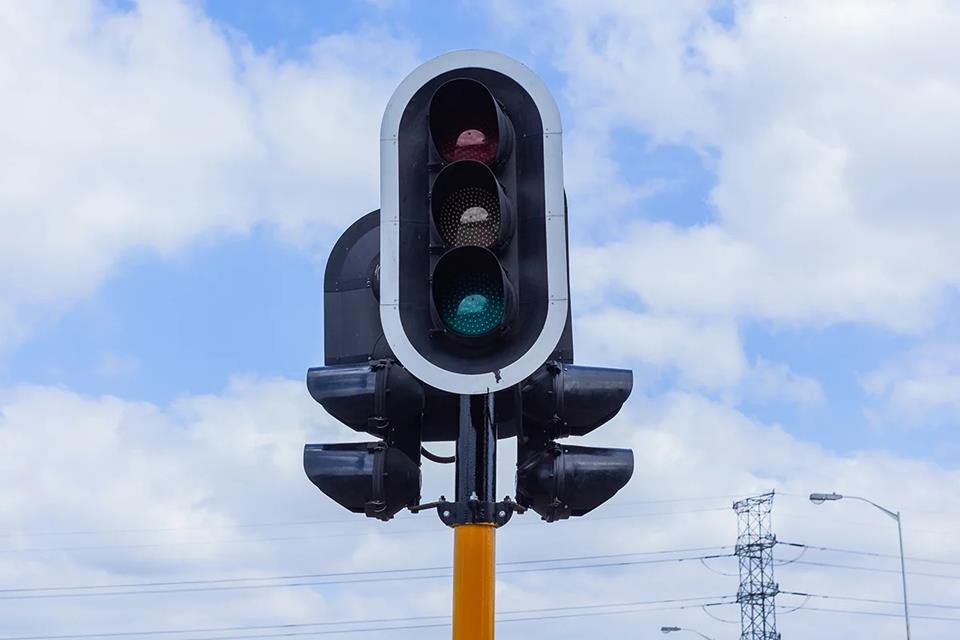
The Automobile Association (AA) of South Africa has called on every municipality to publish a list of its broken traffic lights and streetlights. Each fault should carry a reference number and a repair date. The AA wants the most urgent repairs done before the local government elections on 4 November and the festive season. Transport Month ends this week, but its final days still give government and councils the chance to lead before voters go to the polls: publish the list now and update it weekly.
In July, Kariega businessman Jevon Dyer loaded about five broken traffic lights onto a trailer and offloaded them outside the Nelson Mandela Bay Municipality’s customer care office.* The lights outside his shop in Caledon Street had been out for months, and he said he had seen several accidents and near misses at the intersection. “I thought, why not? I was just tired,” he said at the time. About a week later, the lights were still lying outside the building.
Days after his protest, the metro’s political head for roads and transport, Yolisa Pali-Jongilanga, told a council committee that the city could no longer justify repairing the same traffic lights because thieves stripped their cables within weeks. On the M17, she said, thieves stripped the lights seven weeks after repairs. “We cannot afford to continuously repair the same traffic lights every three months due to repeated acts of vandalism,” she said. “It almost seems as though we are feeding the thieves each time we do repairs.”
Nelson Mandela Bay is not alone. In Pietermaritzburg, some residents wait in afternoon peak traffic for almost an hour when the lights on key routes are out.* In Johannesburg, the Johannesburg Roads Agency (JRA) said in July that more than 300 of its traffic signals had stolen or vandalised equipment. By then, the lights at Chadwick Avenue and 5th Street in Wynberg had been out for more than a year, and the JRA said there was “currently no date for repairs”.* In Polokwane, residents reported in July that 21 intersections had broken lights.*
Some councils have stopped repairing lights at the worst-hit intersections. Ekurhuleni spent roughly R120 million on repairs in a single financial year before replacing signals at some high-risk intersections with stop signs.* The city said some of those stop signs may become permanent. In Centurion, the city decommissioned the signals at Botha and Hoffmeyer streets and downgraded the intersection to a three-way stop.
In Gauteng, the provincial Department of Roads and Transport manages only 547 of the province’s more than 4,500 signalised intersections. In July, it appointed contractors for a repair and restoration programme that it expects to take 36 months.*
“When a traffic light dies, the driver waits. The person on foot takes the gamble,” said Bobby Ramagwede, CEO of the AA. “Mobility is not transport. It is the freedom to get to work, get your children to school, get home again and change your circumstances. Every dead intersection takes some of that freedom away, and it takes it first from the people who walk”.
The AA is asking municipalities to fix routes to schools, polling stations and busy pedestrian corridors first. Responding on Facebook, Nomkhosi Magwaza said: “Some drivers don’t respect pedestrians at a four-way stop. They drive crazy, and you have to beg to go across the road.”*
Many voters will walk to polling stations on 4 November, some of them after dark. Writing in September, Lebogang Tiego Legodi, an associate professor of political science at the University of Limpopo, recalled that queues around Polokwane in 2024 ran so long that some people voted at midnight. With parts of the city without streetlights for more than two years, she asked whether women now wonder, “Will I make it home alive after casting my vote?”*
“No one should have to weigh up that question on election day,” said Ramagwede. “Theft explains a broken light. It does not excuse leaving it broken. The first step costs almost nothing: publish the list. A motorist sitting at a dead robot has no way of knowing whose it is or when it will work again. Tell them, then fix it in the order you said you would.”
Until the lights are fixed, the AA urges voters to plan how they will get to and from their polling station and to keep help within reach. AA Armed Response on the MyAA app lets users call for armed response to wherever they are at the press of a button. The AA is encouraging South Africans to set it up before 4 November, so that help is a tap away on the way to and from the polls.
“We will keep pressing councils to fix the lights,” said Ramagwede. “But a voter walking home in the dark on 4 November needs help that night, not when the repair budget comes through. Where government falls short, the AA can still help.”
These failures also cost businesses and households. The Centre for Risk Analysis has warned that road safety and economic costs rise the longer signals go unrepaired, with insurers and motorists bearing the immediate burden.* The JRA carries a maintenance backlog of more than R115 billion against an annual budget of R1.8 billion. For about a week in June, the City of Johannesburg stopped fueling the agency’s vehicles. Its member of the mayoral committee for transport said field teams were “effectively grounded”.*
Broken lights also burn fuel. A queue at a dead intersection is a line of idling engines in stop-start traffic, and every car in it is burning fuel to go almost nowhere. An idling passenger car uses roughly one to two litres of fuel an hour, depending on engine size and air-conditioning use.* For a commuter stuck for close to an hour in afternoon traffic, that is up to two litres burnt while barely moving, with 95 unleaded costing R30.25 a litre inland this month.
The government announced on 21 October 2026 that petrol would be reduced by R1.50 per litre, and diesel by R3.00 per litre. “The levy cut is good news, but motorists will still feel it at the pump,” said Ramagwede. “The government has a second lever that has nothing to do with the oil price. A driver idling at a broken robot is paying for fuel that takes them nowhere. Fix the light and that money stays in their pocket. It is a saving government can start delivering this week, and it starts with a list.”
Cape Town is piloting a different answer. At some high-risk intersections, the city seals a traffic light’s wiring and components in a buried concrete chamber. Sensors alert law enforcement if someone tries to dig it up, and batteries keep the lights running during power cuts. The city’s mayoral committee has described the chambers as a success.* “If one city can engineer the theft out, every other city owes its residents a costed answer on why it cannot,” said Ramagwede.
Until repairs are done, the AA advises road users to:
- Treat any traffic light that is not working as a four-way stop, as the JRA advises, and take extra care at peak hours and near schools.
- Obey stop signs where a council has replaced a traffic light with these, and expect some drivers not to.
- Keep windows up and valuables out of sight at stop streets and dead intersections, where residents report more smash-and-grabs.
- Slow down on unlit roads and assume there is a pedestrian you cannot see.
- If you are on foot, wear light-coloured or reflective clothing, carry a torch or use your phone’s light, and walk facing oncoming traffic where there is no pavement.
- Walk with others where you can, especially early in the morning and after dark.
- Set up AA Armed Response so that help is a tap away on the way to and from your polling station, and on any walk after dark.
- Report faults to your municipality and keep the reference number. Report suspicious activity around traffic signals and other infrastructure to the authorities, as Gauteng’s Department of Roads and Transport has asked.
- Employers should know how their people get to work
The AA is also asking employers to consider how staff travel before sunrise and after dark. Shift workers often walk to and from work in the dark. Employers can adjust shift times, organise transport or lift clubs, and log every fault on their staff's routes.
Businesses that depend on a particular intersection can help secure it through formal agreements with the municipality that leave responsibility for repairs where it belongs.
“People ask why a mobility organisation cares about the person on foot,” said Ramagwede. “My answer is simple: if it moves, it concerns me. People crossing a dead intersection are road users too.”
Consumers with a mobility-related issue that needs the AA’s mediation can email [email protected].