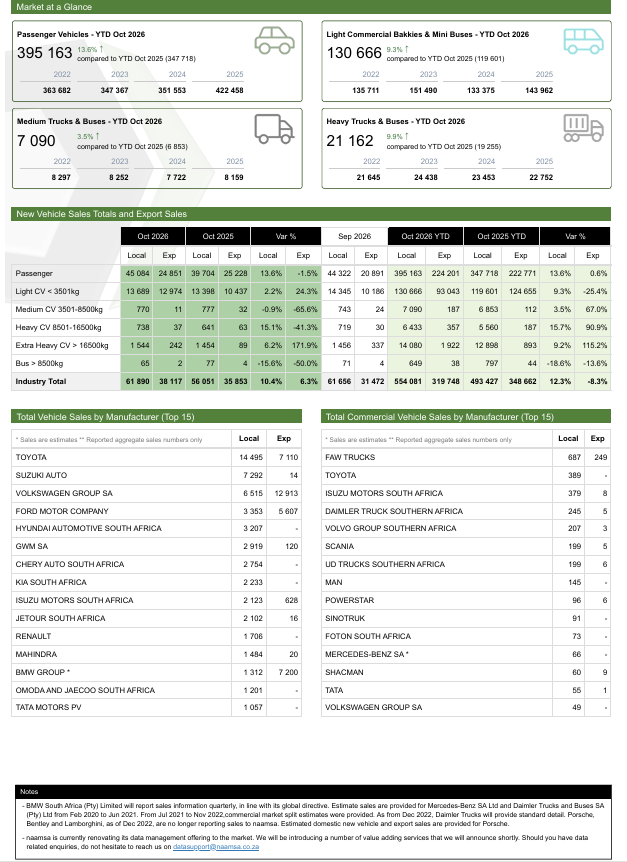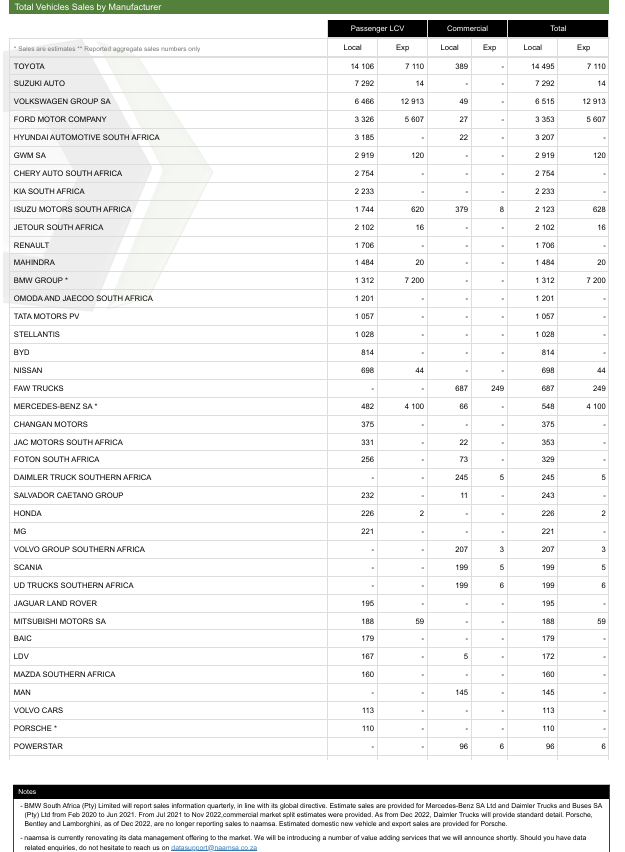
South Africa’s new vehicle market recorded continued growth in October 2026, despite persistent cost-of-living pressures affecting consumers. Aggregate domestic sales reached 61,890 units in October 2026, representing a 5,839 unit, or 10,4% increase compared with the 56,051 units sold during October 2025. Export sales surprised on the upside, reaching 38,117 units and reflecting a 6.3% increase compared with the corresponding month last year.
Of the total reported industry sales of 61,890 vehicles, an estimated 48,234 units, or 78,0% represented dealer sales, 16,5% sales to the vehicle rental industry, 3,3% to government purchases, and 2,2% to corporate fleet sales.
The October 2026 new passenger car market registered 45,084 units, reflecting an increase of 5,380 units, or 13,6% compared to the 39,704 units sold in October 2025. The car rental industry accounted for a sound 21,4% of new passenger vehicle sales during the month.
Domestic sales of new light commercial vehicles, bakkies and minibuses amounted to 13,689 units, representing an increase of 291 units, or 2,2% compared to the 13,398 units sold in October 2025.
Medium commercial vehicle sales reached 770 units during October 2026, a decrease of 7 units, or 0,9% compared to the 777 units sold in October 2025. Heavy truck and bus sales totalled 2,347 units, representing an increase of 175 units, or 8.1%, compared with the 2,172 units sold in October 2025.
Of particular significance was the improvement in export performance during October, following the decline since February 2026. Export volumes increased to 38,117 units, representing a month-on-month increase of 21.1% and year-on-year growth of 6.3%. The improvement was supported by stronger performance in selected vehicle segments, particularly light commercial vehicles and extra-heavy commercial vehicles. Notwithstanding this recovery, cumulative exports for the first ten months of 2026 remained 8.3% below the corresponding period in 2025.
NEW ENERGY VEHICLES (NEVs): SUSTAINED MOMENTUM AND BROADENING POWERTRAIN ADOPTION
South Africa’s New Energy Vehicle (NEV) market continued to demonstrate upward momentum and expanding consumer uptake. Demonstrating extraordinary growth, cumulative NEV sales for the first nine months of 2026 reached 22,389 units, already eclipsing the full-year 2025 total of 16,703 units by 34.0% with a full quarter still remaining.
This acceleration in alternative powertrain adoption is vividly underscored by the milestone that 1 in every 9 cars sold in September was an NEV. Underlying this broader market penetration is a fundamental compositional shift. Having crossed the 50% threshold on a cumulative basis since July 2026, rechargeable vehicles - combining Plug-in Hybrid Electric Vehicles (PHEVs) and Battery Electric Vehicles (BEVs) - accounted for 50.5% of all year-to-date NEV sales in September (8,082 PHEVs and 3,217 BEVs), slightly exceeding the contribution of Traditional Hybrid Electric Vehicles (HEVs), which stood at 49.5% (11,090 units). This illustrates an evolving adoption pathway, as consumers progressively transition along the electrification journey from traditional hybrids toward fully rechargeable powertrains.
Beyond passenger cars, green mobility is progressively extending into commercial vehicle segments, with early-stage adoption taking root across light and medium commercial vehicle segments. While these commercial volumes remain nascent, their emergence signals a vital broadening of South Africa's low-carbon transition from private commuting into commercial logistics and fleet operations.
Sustaining this momentum requires aligning policy frameworks, expanding charging infrastructure, and accelerating local manufacturing to convert growing domestic demand into localized industrial investment, employment, and long-term export competitiveness.
MACROECONOMIC OUTLOOK
The operating environment shaping October’s sales figures was heavily influenced by external cost pressures. Motorists and transport operators faced a sharp increase in fuel prices, with inland 95-octane petrol breaching the R30/litre threshold for the first time, reaching R30.25/litre from 7 October. This represented a 12.4% increase compared with September, reflecting higher international oil prices and supply disruptions. Average Brent crude prices increased to US$101 per barrel during the October fuel-price review period, subsequently rising above US$110 towards month-end. The sharp increase in fuel costs placed additional pressure on consumer purchasing power and fleet operating costs.
Looking ahead, the R10 billion temporary fuel levy relief package announced in the 21 October MTBPS provides some near-term relief, reducing the diesel levy by R3.00/litre and the petrol levy by R1.50/litre from 4 November. However, this does not fully reverse the preceding increases. Based on October price levels, petrol prices would remain approximately 39% above January 2026 levels, while diesel wholesale prices would remain approximately 57% to 61% higher. The intervention therefore provides a tactical buffer rather than a structural solution to elevated transport costs, offering some relief to households, logistics operators and corporate fleets heading into year-end.
Internationally, major central banks in key export destinations - including the Federal Reserve and the European Central Bank - opted to hold policy rates steady during their late-October meetings as they balanced sticky energy-driven inflation risks against fragile global growth. For South Africa's exportoriented automotive manufacturing sector, these holds offer a brief respite from aggressive monetary tightening, though persistent global energy costs and elevated borrowing expenses abroad continue to constrain the pace of external demand recovery.
Domestically, September headline CPI inflation edged higher to 4.5% year-on-year from 4.4% in August, while underlying core price pressures remained relatively contained. Despite the slight acceleration in headline inflation, the domestic new vehicle market continues to demonstrate notable resilience against persistent economic pressures.
As South Africa’s new vehicle market progresses through the final quarter of 2026, the continued growth in domestic sales and accelerating uptake of New Energy Vehicles provide encouraging signals of underlying market resilience and evolving consumer demand. However, sustaining this momentum will depend on strengthening domestic purchasing power, maintaining a competitive and predictable policy environment, and addressing the structural cost pressures affecting both manufacturers and consumers. Equally important is ensuring that the transition towards new energy technologies translates into increased local production, investment and employment. As the industry navigates an increasingly complex global trading environment,
South Africa’s ability to strengthen its domestic market while safeguarding export competitiveness will remain central to the long-term sustainability and growth of the automotive sector.