 It's 21:30. You've been riding since 09:00. Your body knows every pothole on your route by feel. You're doing 58 km/h in a 60 zone on a road you've ridden a hundred times, and somewhere in the back of your mind, you're thinking: I'm fine. I'm under the limit. I know this road.
That thought, right there, is the most dangerous thing about your evening.
Not the road. Not the speed. The certainty.
South Africa's urban delivery sector has grown faster than almost any other segment of the transport industry. Thousands of riders clock daily distances that would exhaust most private motorists, navigating mixed traffic, unmarked hazards, impatient drivers, and time pressure that never really lets up. Most of them do it without any formal safety training. Most of them have never been told what their real risk profile looks like; not in a way that's honest, direct, and written for them.
This article is that conversation.
1. Delivery Riding Is Not the Same as Riding a Motorcycle
Let's be clear about something that the road safety industry often gets wrong: delivery riding is not a variation of riding. It is its own discipline, with its own specific risk factors, and it deserves to be treated that way.
A private rider hops on the bike on a Saturday, does 80 km through the countryside, and parks. A delivery rider does 120 km in stop-and-go urban traffic, under time pressure, with a loaded box on the back, across ten or twelve hours, five or six days a week. The fatigue profile is completely different. The hazard exposure is completely different. The consequences of one mistake are the same, but the number of opportunities for that mistake is multiplied many times over.
Consider what a typical urban delivery shift involves:
Constant stop-and-go riding in mixed traffic wears at your concentration in ways that open-road riding does not. Every intersection is a decision point. Every taxi offload is a potential emergency. Every pedestrian stepping off a pavement without looking is a hazard that requires an active response. Do that two hundred times in a day, and your attention budget runs dry faster than you think.
Add time pressure to that equation: orders waiting, ratings affected, income dependent on completion speed, and you have a rider whose brain is already spending cognitive resources on logistics while also trying to manage a moving vehicle in a hostile environment.
This is the real risk profile. It is not about bad riders. It is about a demanding system operating on human beings with finite capacity. Understanding this is the first step toward managing it.
2. "I Was Under the Limit" Is Not the Same as "I Was Safe"
Here is a question worth sitting with: if you hit and seriously injure a pedestrian while riding at 58 km/h in a 60 km/h zone, would the speed sign protect you? Would it bring them back?
The posted speed limit tells you one thing only: the maximum legal speed for that road under normal conditions. It says nothing about whether your current speed is appropriate for the specific environment you are riding through right now.
Think about what 60 km/h means in terms of physics. At that speed, from the moment you register a hazard to the moment you even begin pressing the brake lever, you have already travelled roughly 17 metres, and that's assuming a reaction time of one second, which is optimistic for a rider in the twelfth hour of a shift. Add braking distance on top of that, and a child stepping out from behind a parked car 20 metres ahead is not a survivable scenario. Not at 60. Not even at 55.
Now put that child at a taxi stop in a residential area, or outside a school at pickup time, or at an informal settlement where the pavement and the road are the same piece of ground. The posted limit has not changed. The risk has multiplied dramatically.
This is not an argument for riding at 20 km/h everywhere. It is an argument for using your own judgement, consistently and deliberately, to match your speed to the actual environment rather than relying on a sign to do your thinking for you.
Some environments demand 40 km/h even when the sign says 60. A busy pedestrian crossing. A residential street with cars parked on both sides and no sightlines. A shopping area on a Saturday afternoon. A school zone at 14:30.
The riders who survive long careers develop an instinct for reading these environments and adjusting before the hazard appears, not after. That instinct is not luck. It is a skill. And like every skill, it is learned.
3. The Night Shift Is a Different Ride
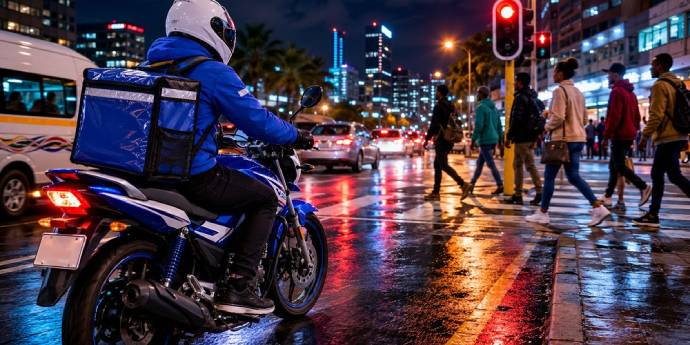
More than a third of urban delivery kilometres happen after 20:00. If you are a delivery rider, a significant portion of your working life is spent in conditions that are measurably more dangerous than daylight riding, and most riders treat night riding the same as day riding. Same speed. Same following distance. Same level of alertness. That mismatch is costing lives.
Here is what changes when the sun goes down:
Your eyes are slower than you think. In daylight, your vision is sharp and wide. In darkness, your peripheral vision degrades, your depth perception becomes less reliable, and your brain takes longer to process what it is seeing. A pedestrian in dark clothing on an unlit road can be effectively invisible until they are five or six metres in front of you. At 60 km/h, five metres is not a distance. It is an inevitability.
Pedestrians become harder to see, but they don't become less common. People walk home from taxi stops after dark. People cross unlit roads between streetlights. People are less visible, which means less time to react.
Fatigue compounds everything. After eight or ten hours on the bike, your reaction time is meaningfully slower than it was at the start of your shift. Research consistently shows that fatigue impairs decision-making and reaction speed in ways that riders systematically underestimate. You feel like you're fine. You are not as fine as you feel.
Other road users are more likely to be impaired. Evening and late-night traffic carries a higher proportion of drivers who are fatigued, distracted, or, in some cases, drunk. Their behaviour is less predictable, and their reaction times are worse than during the day.
What does this mean practically? It means night riding requires conscious, deliberate adjustments:
Reduce your speed below the posted limit, not because the law requires it, but because your stopping distance needs to reflect what you can see ahead of you. If your headlight illuminates 30 metres of road and you need 35 metres to stop, you are already in trouble.
Increase your following distance. The three-second rule that applies during the day should become four or five seconds after dark.
Use your high beam on unlit roads. The brief inconvenience to oncoming traffic is worth the visibility gain.
If fatigue hits, real fatigue, the kind where you catch yourself reacting a beat late or losing focus mid-ride, stop. Pull over, switch the bike off, and rest for ten minutes. Ten minutes of rest is worth more than three additional deliveries if the alternative is a mistake you cannot undo.
The night shift is not just the day shift in the dark. Ride it accordingly.
4. The Speed Creep That Nobody Talks About
When road safety discussions focus on speeding, they almost always focus on the dramatic end: the rider doing 120 in a 60 zone, the red-light runner, the overtake on a blind rise. These behaviours are real risks, but they are not the most common form of speed non-compliance among delivery riders.
The most common form is quieter and far more insidious: riding five to ten kilometres per hour above the posted limit, consistently, throughout an entire shift, because that is simply how the rhythm of the job has settled.
It does not feel like speeding. It feels like keeping up with traffic. It feels like being efficient. It has become the baseline.
But consider what sustained above-limit riding does to you over a full shift:
Your safety buffer, the space around you, and the time between you and the next hazard, is smaller every single kilometre. Not by much, individually. But multiply a slightly compressed buffer across a hundred stops and a hundred intersections and a hundred pedestrian crossings, and the cumulative probability of one of those compressed moments coinciding with a serious hazard increases meaningfully.
Your body and brain are operating at a slightly higher alert level all day, which accelerates fatigue. Riding at 68 km/h in urban traffic demands more constant micro-adjustments than riding at 58 km/h. That difference is small in the short term and significant over ten hours.
Your stopping distance in an emergency is longer than it would be at a legal speed, every single time. That extra three metres at 68 km/h versus 60 km/h is the difference that matters on the day it matters.
The fix is not complicated. It is just unpopular: ride to the limit, or below it when the environment warrants. Trust that the time difference across a full shift is far smaller than it feels, and that the safety margin you gain is real, even when the risk it prevents stays invisible.
.JPG)
5. If You Are Braking Hard, You Were Already Late
Emergency braking feels like a skill. It is not. Or rather, it is the last resort of a rider who has run out of the actual skill, which is anticipation.
When a rider grabs the front brake or steps on the rear brake hard, when the deceleration is sharp and sudden, and the heart rate spikes, it is almost never because something truly materialised out of nowhere. It is because the hazard was there, ahead, giving signals, and the rider did not see it far enough in advance to manage it smoothly.
The pedestrian was walking toward the road for several seconds before they stepped off the kerb. The car that pulled out was sitting at that side street with its wheels turned for longer than you noticed. The taxi that stopped was slowing down for three hundred metres before it stopped.
The riders who rarely brake hard are not the ones with better reflexes. They are the ones who identified the hazard early enough that braking was a calm, planned response rather than a last-moment grab.
This is called anticipatory riding, and it is built on one habit: keeping your eyes up, scanning far ahead, and processing what you see before you are level with it.
The S.E.E. principle gives it a practical framework:
Search - Eyes up and scanning the road at least ten to twelve seconds ahead. Not the rear wheel of the vehicle in front of you. Not your phone. The horizon.
Evaluate - What is that pedestrian likely to do? Is that car going to pull out? Why is that taxi slowing? Run the scenario a beat before it unfolds.
Execute - Cover your brake lever. Adjust your lane position. Change speed before the hazard reaches you.
Cover your brake lever whenever you are in an environment with potential hazards, which, in urban delivery riding, means nearly all the time. Covering the lever removes the mechanical delay from your response. If your fingers are already touching the lever, you are already a fraction of a second ahead.
If you find yourself braking hard regularly, that pattern is telling you something. You are either following too closely, riding too fast for the conditions, or not scanning far enough ahead. Usually, some combination of all three. The solution is not better braking, it is earlier seeing and anticipation.
6. The More You Ride, the More Discipline You Need
There is a belief, common among experienced delivery riders, that high mileage is a form of protection. You know the roads. You have seen everything. Your reflexes are sharpened by repetition.
Some of this is true. Familiarity with a route does help. Pattern recognition built over thousands of kilometres is genuinely useful.
But it also carries a risk that experienced riders rarely acknowledge: complacency.
Familiarity with a road makes you less likely to actively scan it. You know what is usually there, so your brain starts to process the familiar route on autopilot. And autopilot is exactly the state you do not want to be in when the unusual thing happens, because the unusual thing, by definition, is the one your pattern recognition did not prepare you for.
More importantly, consider the raw mathematics of exposure. A rider doing 150 km a day has five times the number of intersections, five times the pedestrian crossing points, and five times the opportunities for another driver to make a mistake that affects them, compared to a rider doing 30 km a day. Five times more moments where one lapse in concentration could coincide with one hazard at exactly the wrong time.
Experience is valuable. But experience does not reduce exposure. Only discipline does that.
The riders who reach career milestones without serious injuries are not the ones who rode the most. They are the ones who rode with consistent, deliberate attention to their safety margins, every shift, every kilometre, regardless of how familiar the road felt.
Volume is not experience; it is exposure. Treat it accordingly.
7. The Mindset That Keeps You Alive
Everything above, the speed management, the night awareness, the anticipatory riding, the discipline over long careers, flows from a single upstream decision: the decision to take your own safety seriously as a professional standard, not just as a personal preference.
This matters because delivery riding creates specific psychological pressures that work against safe behaviour. Time pressure rewards speed. Familiarity breeds complacency. Financial stress creates shortcuts. Peer culture can normalise risk-taking. All of these forces push in one direction.
Choosing to push back against them is not about being timid. It is about being professional in the genuine sense of the word; someone who applies skill and judgement consistently, who understands the system they operate in, and who makes deliberate decisions rather than reactive ones.
The riders who internalise this shift stop thinking about traffic violations as rules someone else imposed and start thinking about them as decisions with consequences they own. A stop sign is not a bureaucratic inconvenience. It is the thirty seconds that separate a
T-bone from a clean crossing. A speed limit in a residential area is not a suggestion. It is the difference between a near-miss and a fatality.
Crashes are not accidents. They are the downstream result of a chain of choices, most of which seemed small and reasonable at the time. Changing outcomes means changing choices, specifically the small, quiet ones that happen fifty times a shift when nobody is watching.
One Last Thing
If you are a delivery rider who has read this far, you already know something that most road safety content fails to acknowledge: your job is hard. The conditions are demanding. The system puts pressure on you in ways that make the safe choice feel like the slow choice.
This article is not here to judge that. It is here to offer a different frame: the rider who manages their risk intelligently, who rides to the environment rather than just the sign, who keeps their eyes up and their speed appropriate and their safety buffer intact, that rider is more likely to be riding next year. And the year after. And still be delivering when the riders who took the shortcuts are not.
That is not luck. That is a choice you make every shift.
Ride to deliver. Ride to live!
The Motorcycle Safety Institute of South Africa (MSI) provides accredited motorcycle safety training for commercial and private riders across South Africa. Our Urban Rider Course (URC) and Urban Master Class (UMC) are designed specifically for the conditions South African riders face every day. For more information, visit www.msi.org.za.
Published by the Motorcycle Safety Institute of South Africa | www.msi.org.za
© Motorcycle Safety Institute of South Africa. All rights reserved. This article may be shared freely for non-commercial road safety purposes with attribution.
Also View
Safety and the Delivery Bike Rider
Bike Crashes, Visibility and Motorcycle Safety
Motorbike Safety through the Eyes of the Instructor
Motorcycle Safety and Riding in Bad Weather
Motorcycle Insurance and Safety on the Road
Motorcycle Safety and ATGATT